
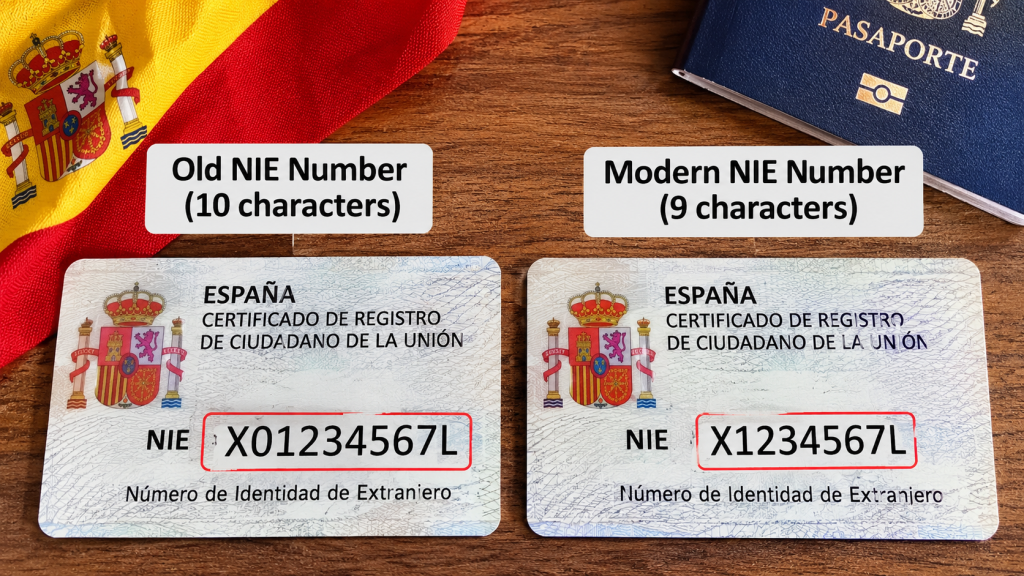
Did you know that Spanish NIE Numbers were once composed of ten characters instead of the nine we recognise today?
Millions of foreign nationals use a Spanish NIE Number to purchase property, pay taxes, open bank accounts, work and conduct financial transactions in Spain. However, relatively few people are aware of the historical changes made to the Spanish foreign identification numbering system.
Some foreign nationals who established connections with Spain decades ago may still possess original documents displaying a ten-character NIE Number.
These historical identification numbers can potentially cause confusion when dealing with modern Spanish administrative systems.
In this specialist guide, NIE Numbers Spain examines the history of the ten-character NIE Number, the administrative agreement reached in 1997, the legislative reforms of 2008 and what you should do if your old Spanish NIE Number is not recognised.
What was the original format of a Spanish NIE Number?
The NIE, officially known as the Número de Identidad de Extranjero, is the personal identification number allocated by the Spanish authorities to foreign nationals.
Although the modern Spanish NIE Number contains nine characters, the original format formally contained ten.
The historical format consisted of:
- The initial letter X.
- Eight numerical digits.
- A final alphabetical verification character.
A fictional example of the historical format would be:
X01234567L
In comparison, the modern representation of this example would be:
X1234567L
The additional zero immediately following the letter X is the important difference.
These examples are illustrative and do not represent verified identity records.
The historical format is explained in the official technical guidance published by the Spanish Tax Agency, the Agencia Tributaria.
Why did Spain originally use a ten-character NIE Number?
Spain’s foreign identification system developed under different administrative and technological circumstances from those that exist today.
Before the widespread adoption of electronic government services, identity documents were designed around the requirements of individual government departments and administrative systems.
The foreign identification numbering system originally used a different character length from the Spanish fiscal identification system.
This created an administrative compatibility problem because the Spanish NIF, or Número de Identificación Fiscal, was composed of nine characters, whereas the older NIE format contained ten.
As foreign nationals increasingly participated in the Spanish economy, consistent identification became important for taxation, property ownership, financial transactions and government administration.
The two systems needed to operate together more effectively.
The 1997 agreement between the Spanish Tax Agency and the Ministry of the Interior
One of the most interesting developments in the history of Spanish NIE Numbers occurred in 1997.
According to the official Spanish Tax Agency documentation, the Ministry of the Interior and the Agencia Tributaria reached an agreement to address the difference in length between the NIE and NIF.
The solution was to omit the redundant zero immediately after the letter X when recording the relevant identification number in administrative databases.
| Historical NIE format | Standardised NIE format |
|---|---|
| X01234567L | X1234567L |
| 10 characters | 9 characters |
This allowed the same identity to be represented within the existing nine-character fiscal identification framework.
Importantly, this was a formatting adjustment rather than the allocation of an entirely new identity number.
The agreement also explains why some older documents may contain an additional zero while more recent correspondence concerning the same individual does not.
Why Spain needed to change the NIE Number system again in 2008
The 1997 solution depended on the additional numerical position being occupied by a zero.
However, as increasing numbers of foreign nationals obtained Spanish NIE Numbers, the available numbering capacity became an issue.
Spain needed a way to expand the system without increasing its length.
The solution was to introduce additional alphabetical prefixes.
On 14 July 2008, the Spanish Ministry of the Interior issued Orden INT/2058/2008.
The legislation was published in the Boletín Oficial del Estado (BOE) on 15 July 2008 and entered into force the following day.
This order formally established a nine-character NIE structure, with additional letter sequences becoming available after the existing series was exhausted.
The original legislation can be consulted directly on the Spanish government’s official website:
Orden INT/2058/2008 – Official Spanish NIE Number reform
How the modern Spanish NIE Number is structured
The standard NIE Number used today consists of nine characters.
| Component | Purpose |
|---|---|
| X, Y or Z | Initial identification series |
| Seven numerical digits | Identification sequence |
| Final alphabetical character | Mathematical verification |
Illustrative formats include:
- X1234567L
- Y1234567X
- Z1234567R
The initial letter does not determine the nationality, residency status or tax residency of the holder.
An individual with an older X-prefix NIE Number does not have greater or fewer legal rights simply because their identification number belongs to an earlier numbering series.
For a detailed explanation of the mathematical structure, read our specialist guide to Spanish NIE Number validation and verification.
Timeline of the historical NIE Number reforms
| Date | Development |
|---|---|
| Before the 1997 agreement | Historical ten-character NIE structure |
| 1997 | Administrative agreement to standardise the displayed format |
| 14 July 2008 | Ministerial order formally adopted |
| 15 July 2008 | Legislation published in the BOE |
| 16 July 2008 | New legislation entered into force |
| Modern system | Nine-character NIE Numbers using the permitted X, Y and Z prefixes |
Is an old ten-character Spanish NIE Number still legally valid?
Yes. The fact that a Spanish NIE Number was allocated before the 2008 reforms does not, by itself, invalidate it.
One of the most significant provisions of Orden INT/2058/2008 is its transitional protection for previously allocated identification numbers.
The legislation specifically establishes that NIE Numbers allocated before the order entered into force retain their validity indefinitely.
This is particularly important for foreign nationals who:
- Purchased property in Spain many years ago.
- Previously lived or worked in Spain.
- Opened a Spanish bank account decades ago.
- Inherited Spanish property.
- Returned to Spain following a lengthy absence.
- Hold historical Spanish tax documents.
An older NIE Number does not become invalid simply because Spain subsequently changed the numbering format.
However, the validity of the identification number must be distinguished from the validity or administrative acceptance of the document displaying it.
You may need an updated certificate confirming your existing NIE Number without being allocated a new number.
Why is my old Spanish NIE Number not recognised?
Foreign nationals sometimes encounter difficulties when attempting to use historical NIE documentation with modern electronic services.
A rejected NIE Number does not necessarily mean that the number is invalid.
There are several possible explanations.
1. The original NIE Number contains an additional zero
A website may accept only nine characters.
If your historical document contains ten characters beginning with X0, the system may expect the standardised representation.
Compare the number with more recent official correspondence before submitting it.
2. Your NIE Number has been recorded inconsistently
Different organisations may hold different representations of your historical identification number.
For example, an old property deed could display the original number, while more recent tax correspondence uses its standardised equivalent.
Where necessary, ask the relevant organisation to compare its records with your official identity documentation.
3. Your personal details have changed
You may have changed your surname, renewed your passport or obtained another nationality since your NIE Number was originally allocated.
Differences between historical and current personal information can cause identity verification difficulties.
4. Your tax registration requires updating
Having a NIE Number allocated by the Spanish police does not necessarily mean your current details are correctly registered with every government department.
If the problem specifically concerns taxation, it may be necessary to contact the Agencia Tributaria to review your fiscal identification records.
5. The website has been incorrectly programmed
Some commercial websites have restrictive identification fields.
A failure to accommodate historical formats or foreign identification numbers correctly could prevent a legitimate NIE Number from being accepted.
If your official paperwork is correct, contact the organisation responsible for the website.
How to convert an old ten-character NIE Number into the modern format
Where the historical format genuinely contains a redundant zero immediately after X, the standardisation described by the Spanish Tax Agency involves removing that zero.
For example:
Historical format: X01234567L
Standardised format: X1234567L
The remaining digits and final verification letter are unchanged.
However, this does not mean you should automatically remove a digit from every ten-character number appearing on a Spanish document.
You should first establish:
- Whether the number is actually your NIE Number.
- Whether the additional character is part of a historical document format.
- Whether your more recent official records display a nine-character equivalent.
- Whether the resulting number passes the official mathematical verification.
If there is any uncertainty, request confirmation from the Spanish National Police or the relevant authority.
Never alter an original official identity document yourself.
Can I check whether my old NIE Number is mathematically correct?
Yes. The Spanish Ministry of the Interior publishes the mathematical method used to calculate the final verification letter of a standard NIE Number.
The calculation assigns the following numerical values to the initial letter:
| Initial letter | Numerical value |
|---|---|
| X | 0 |
| Y | 1 |
| Z | 2 |
The resulting numerical value is checked using a division-by-23 calculation.
This determines the expected final verification character.
The official calculation is available here:
Spanish Ministry of the Interior – NIE and NIF verification calculation
Remember that mathematical validation only establishes whether the number follows the expected calculation. It does not prove that the Spanish police allocated the number to you or to another individual.
Old Spanish NIE Numbers and property ownership
Historical NIE Numbers can be particularly relevant to foreign nationals who purchased Spanish property many years ago.
Spain has long attracted international property buyers, particularly in coastal regions such as Alicante, Málaga, Murcia and the Balearic Islands.
Some property owners may retain original documentation dating back several decades.
When preparing to sell or transfer a property, they may discover that a historical identification number appearing on their original escritura is represented differently in modern administrative records.
This could become relevant when dealing with:
- Spanish notaries.
- The Land Registry.
- The Catastro.
- Municipal tax authorities.
- Spanish banks.
- Capital gains tax declarations.
- Inheritance proceedings.
- Non-resident tax obligations.
A formatting difference does not automatically affect the validity of property ownership.
However, the identity of the owner must be established satisfactorily during the transaction.
If you discover a discrepancy, raise the matter with your notary or legal representative before the planned completion date.
Historical NIE Numbers and Spanish inheritance
Another situation where an older NIE Number may become relevant is the administration of a Spanish inheritance.
An individual may have purchased property in Spain decades earlier and subsequently passed away.
Their beneficiaries could discover historical documentation containing a ten-character identification number.
The same person’s later tax records or administrative documents may display a different representation.
Before concluding that the deceased held two separate NIE Numbers, the beneficiaries should establish whether the difference relates to historical formatting.
Preserving original paperwork can be particularly valuable when reconstructing a person’s administrative and property ownership history.
Old NIE Numbers and the Spanish Cl@ve identification system
The historical presentation of foreign identification numbers can also be relevant when registering for Spanish electronic government services.
Official Cl@ve technical guidance includes explanations of additional characters appearing on certain identification documents and how these should be entered into the registration system.
This demonstrates the importance of distinguishing between the number printed on a particular document and the format required by an electronic service.
Applicants should also remember that the NIE Number is not the same as the número de soporte, which identifies an individual document.
More information can be found in the official Cl@ve registration office guidance.
Do I need to apply for a new NIE Number if mine is very old?
Generally, no.
If you were previously allocated a Spanish NIE Number, your first step should be to establish and confirm your existing identification number.
Applying for a second number could create unnecessary administrative complications.
Instead, consider requesting an updated NIE certificate or reviewing your identity records with the appropriate authority.
Useful supporting documentation may include:
- Your current passport.
- Your original NIE certificate.
- Previous passports, where available.
- Historical Spanish residence documents.
- Spanish property deeds.
- Tax correspondence displaying your NIE Number.
- Evidence of any legal name changes.
The documentation required will depend on the circumstances and the administrative procedure involved.
For general information about NIE appointments and application procedures, visit our complete guide to NIE Numbers in Spain.
What should I say at the Spanish police station?
If you need to explain that you have an older NIE Number and wish to confirm its modern format, the following Spanish wording may be helpful:
Tengo un NIE antiguo que aparece con diez caracteres en mi documentación original. Quisiera comprobar cuál es su formato actual y solicitar, si procede, un certificado actualizado del NIE que ya tengo asignado. No deseo solicitar un nuevo número.
English translation:
I have an old NIE that appears with ten characters on my original documentation. I would like to confirm its current format and, if appropriate, request an updated certificate for the NIE already allocated to me. I do not wish to apply for a new number.
Frequently asked questions about old Spanish NIE Numbers
Does a Spanish NIE Number expire after 20 or 30 years?
No. The age of your NIE Number does not automatically invalidate it. Other documents and administrative registrations may require updating.
Why does my old NIE Number have eight numerical digits?
It may originate from the historical ten-character identification format used before the formal 2008 changes.
Can an old NIE Number begin with X0?
Yes. Historical documents may contain an additional zero after the initial letter X.
Can I simply remove the first zero?
For the specific historical format described by the Spanish Tax Agency, removing the redundant zero produces the standardised representation. Confirm that this applies to your particular documentation before relying on it.
Does changing the format mean I have been allocated a new NIE Number?
No. Standardising the historical representation does not itself constitute a new allocation.
Can I change my old X NIE Number to a Y NIE Number?
An older prefix is not a reason to request a replacement identification number. The NIE should remain associated with the person to whom it was allocated.
Can I use an old NIE Number to purchase or sell property in Spain?
An older NIE Number can remain valid. However, your notary may require current documentation confirming your identity and identification number.
Does an old NIE Number prove that I have Spanish residency?
No. Historical possession of a NIE Number does not establish current Spanish residency rights.
Can my old NIE Number be reassigned to another person?
The NIE system is designed to provide a unique personal identifier. An individual’s departure from Spain or prolonged absence is not a reason for their number to be reassigned.
What should I do if I have lost my original NIE certificate?
Contact the relevant Spanish authority to establish your existing identification number and determine the appropriate procedure for obtaining updated documentation.
Conclusion: Understanding the forgotten ten-character NIE Number
The Spanish NIE Number has evolved alongside Spain’s administrative, technological and economic development.
The historical ten-character format is a reminder that identification systems are not static. Administrative procedures must adapt to population growth, electronic services and changing government requirements.
For foreign nationals holding historical Spanish identification documents, the most important distinction is between the formatting of the number and the continued validity of the identity originally allocated.
The 1997 administrative agreement and the 2008 legislative reform explain why older documentation may look different from the NIE Numbers issued today.
If you experience problems with a historical NIE Number, establishing its correct administrative representation is generally more appropriate than attempting to obtain a new identification number.
Further reading: NIE Number guides
Explore more specialist information from NIE Numbers Spain:
- How to Get a NIE Number in Spain – Complete Guide
- NIE Number Validation – How Spanish NIE Numbers Work
- Top 50 Most Asked Questions About Spanish NIE Numbers
Official Spanish government sources and legislation
This article has been researched using the following official government publications:
- Agencia Tributaria – Composition and Accreditation of the Spanish NIE Number
- Boletín Oficial del Estado – Orden INT/2058/2008
- Ministry of the Interior – Official NIE Verification Character Calculation
- Agencia Tributaria – Cl@ve Registration Office Technical Guidance
This article provides general information based on published Spanish government documentation. Individual administrative circumstances may require confirmation from the Spanish National Police, Agencia Tributaria or an appropriately qualified professional.
Last reviewed: 27 November 2026.