
Updated: November 2026
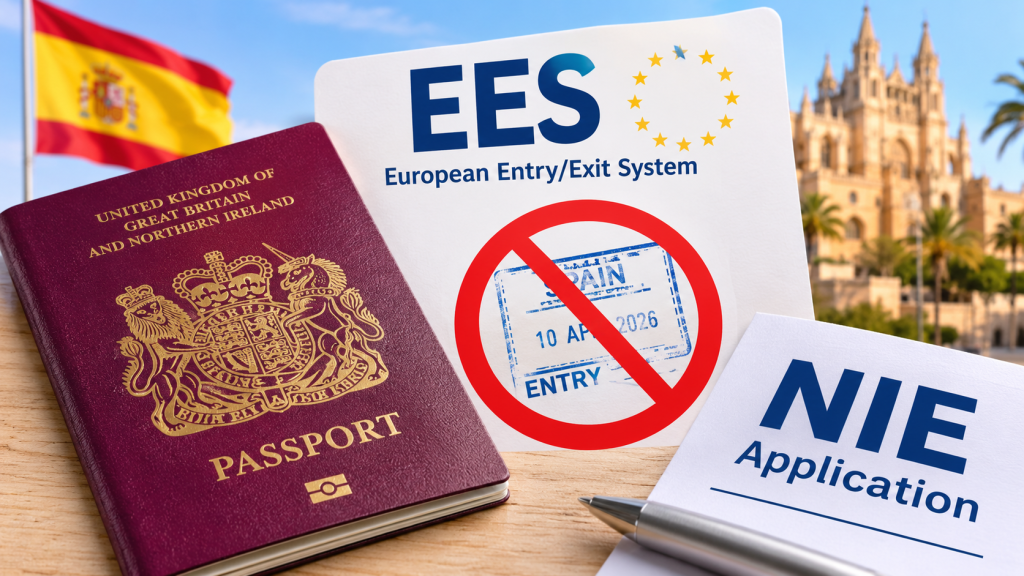
The introduction of the European Entry/Exit System (EES) represents one of the biggest changes to European border controls in decades. For British, American, Canadian, Australian and other non-EU citizens applying for an NIE number in Spain, the disappearance of traditional passport stamps raises several important questions.
Can you still apply for an NIE number without an entry stamp? How does the Spanish National Police establish when you entered Spain? Will you need to provide additional documentation at your NIE appointment?
Historically, passport stamps provided a straightforward way of demonstrating when a non-EU national entered the Schengen Area. However, with the introduction of digital border records, applicants must understand how the new system operates and what evidence they should retain.
In this guide, we explain how EES affects NIE number applications in Spain, how to demonstrate legal entry and what you should bring to your Spanish police appointment.
What is the European Entry/Exit System (EES)?
The European Entry/Exit System, commonly referred to as EES, is an electronic border management system introduced across participating European countries, including Spain.
The system began its phased introduction on 12 October 2025 and became fully operational on 10 April 2026.
EES replaces traditional passport stamping for travellers covered by the system with electronic records containing information about:
- Passport and personal identification details.
- Date and location of entry into the Schengen Area.
- Date and location of departure.
- Facial biometric information.
- Fingerprints, where applicable.
- Refusals of entry.
- Compliance with authorised periods of stay.
Instead of relying on ink stamps inside passports, European immigration authorities can now use electronic border records.
For millions of British citizens travelling to Spain each year, this represents a fundamental change in how their immigration status is recorded.
Can I get an NIE number without a passport entry stamp?
Yes. The absence of a traditional passport entry stamp does not automatically prevent you from applying for an NIE number in Spain.
However, one of the existing requirements for obtaining a standalone NIE number in Spain is that the applicant must not be in an irregular immigration situation.
The Spanish Ministry of the Interior also requires applicants to explain the economic, professional, social or other reasons for requesting their NIE number.
These requirements have not disappeared with the introduction of EES.
What has changed is the way immigration authorities record entry into the Schengen Area.
If you have entered legally through an external Schengen border and your entry has been registered electronically, the absence of a physical stamp is now a normal consequence of the new border system.
Applicants should nevertheless be prepared to provide supporting documentation if requested.
Why was the passport stamp important when applying for an NIE number?
Before EES, passport entry stamps provided Spanish police officers with a convenient way of establishing when a non-EU applicant had entered the Schengen Area.
For example, a British citizen travelling to Alicante to purchase a property might enter Spain, attend an NIE number appointment and present their passport containing a recent entry stamp.
The stamp helped establish whether the applicant was still within their permitted period of stay.
For many British visitors, this means a maximum of 90 days within any rolling 180-day period across the Schengen Area.
With the introduction of EES, the underlying immigration requirement remains, but the method of recording border crossings has changed.
The important distinction is that Spanish immigration law requires applicants to be legally present when applying in Spain, rather than universally requiring a physical passport stamp.
How will the Spanish police check my legal entry into Spain after EES?
Authorised border and immigration officials can access EES information for permitted immigration-related purposes.
This means that electronic records can be used to establish the immigration history of travellers covered by the system.
However, applicants should not assume that every police station processing NIE applications has immediate access to every EES function or that all offices follow an identical verification procedure.
Administrative processes may differ between locations, and officers may request additional supporting evidence.
For this reason, we recommend retaining your travel documents until your NIE number application has been completed.
What documents should I bring to my NIE number appointment after EES?
In addition to the normal NIE application documents, non-EU applicants should consider bringing evidence of their recent journey.
| Document | Purpose |
|---|---|
| Original valid passport | Establishes your identity |
| Photocopy of your complete passport | Supports your application |
| Completed EX-15 application form | Official NIE number application |
| Modelo 790 Código 012 payment receipt | Evidence of payment of the government fee |
| Evidence of why you need an NIE | Establishes the purpose of your application |
| Flight boarding pass | Supporting evidence of your journey |
| Airline booking confirmation | Supports your travel history |
| Ferry or train tickets | Alternative evidence of travel |
| Residence permit or relevant visa, if applicable | Demonstrates immigration status |
| Declaration of entry, where applicable | Records entry into Spain |
Not all of these documents are compulsory for every applicant. Travel records are recommended as supplementary evidence, particularly now that traditional passport stamps are being replaced.
A boarding pass is not, by itself, conclusive proof of lawful immigration status.
Should I keep my boarding pass after entering Spain?
Yes. We strongly recommend that anyone travelling to Spain to obtain an NIE number retains their boarding pass and travel booking confirmation.
Many travellers use electronic boarding passes that are automatically removed from airline applications after their flight.
Before travelling, consider downloading or taking a screenshot of your boarding pass.
You may also wish to retain:
- Airline confirmation emails.
- Return flight reservations.
- Ferry tickets.
- Eurostar tickets.
- Accommodation confirmations.
- Relevant travel receipts.
These documents may help demonstrate your movements if questions arise during an administrative appointment.
Although they do not replace an official immigration record, they can provide useful supporting evidence.
What if I enter Spain through another European country?
This is one of the most important differences between entering the Schengen Area and entering Spain itself.
Imagine that you are a British citizen travelling from London to Paris before continuing to Alicante.
Your EES entry record will normally be created when you enter the Schengen Area in France, rather than when you arrive in Spain.
Similarly, if you drive from the United Kingdom through France and into Spain, your external Schengen border crossing will be recorded before you reach Spain.
EES does not normally register movements between participating countries.
Consequently, your electronic entry record may establish when you entered the Schengen Area without establishing the precise date on which you arrived in Spain.
This makes retaining your onward travel documentation particularly important.
You may also be required to complete a Spanish declaration of entry.
What is a Declaración de Entrada in Spain?
The Declaración de Entrada, or declaration of entry, is an existing Spanish administrative procedure that records a foreign national’s arrival in Spain in certain circumstances.
According to the Spanish Ministry of the Interior, eligible third-country nationals entering Spain from a country with which internal border checks have been abolished, and who do not hold Spanish residence authorisation, are required to declare their arrival.
Certain nationality exemptions apply.
Where the declaration is required and has not been completed upon arrival, it must normally be made within three days of entering Spain at a National Police station.
The declaration may be particularly relevant to British citizens who:
- Drive through France into Spain.
- Fly into Spain from another Schengen country.
- Travel through Portugal before arriving in Spain.
- Enter Spain by train from France.
- Arrive in Spain without crossing an external Schengen border.
The Declaración de Entrada is not a new requirement created by EES. However, it is especially important to understand the procedure now that traditional passport stamps are disappearing.
If your journey involves entering Spain from another Schengen country, check whether this requirement applies to you.
Does EES change the 90/180-day rule for British citizens?
No. EES does not introduce a new permitted period of stay for ordinary British visitors.
British passport holders travelling visa-free generally remain entitled to spend up to 90 days within any rolling 180-day period across the Schengen Area.
What EES changes is the way those days are recorded and monitored.
Previously, immigration officials often relied on passport stamps to calculate travel history. Digital records now make it easier to identify travellers who have exceeded their authorised stay.
Anyone travelling to Spain to obtain an NIE number should carefully calculate their remaining permitted days before booking their appointment.
Importantly, obtaining an NIE number does not:
- Reset your 90-day allowance.
- Extend your authorised stay.
- Grant Spanish residency.
- Automatically provide permission to work in Spain.
- Exempt you from EES registration.
- Legalise an existing immigration overstay.
An NIE number is an identification number, not an immigration permission.
Can I apply for an NIE number if I have overstayed in Spain?
The Spanish Ministry of the Interior states that applicants requesting an NIE for economic, professional or social reasons must not be in an irregular immigration situation in Spain.
If you have exceeded your permitted period of stay, this could therefore affect your ability to obtain a standalone NIE number through the usual EX-15 application process.
The introduction of EES makes the monitoring of overstays more systematic.
If you believe you have exceeded your permitted stay, obtain appropriate immigration advice before making an application.
Having an NIE appointment booked does not give you permission to remain in Spain beyond your authorised period.
How can I check my EES immigration records?
Individuals whose personal information is recorded in the Entry/Exit System have data protection rights.
These include the right to request access to their personal data and to seek correction of inaccurate or incomplete information.
If you believe your arrival or departure has been recorded incorrectly, you can contact the relevant competent authorities to request assistance.
The European Union also provides an online service for checking the remaining duration of an authorised short stay.
However, a calculation of your remaining days is not necessarily equivalent to an official certificate of entry.
If an incorrect EES record could affect your NIE application, it is advisable to address the problem before attending your appointment.
Are British TIE card holders affected by EES?
British citizens who hold valid Spanish residence documentation, including qualifying TIE cards issued under the Brexit Withdrawal Agreement, are generally exempt from EES registration.
They should present their valid residence documentation alongside their passport when crossing the relevant border.
Having a Spanish NIE number alone does not provide this exemption.
This distinction is important:
| Spanish document | Does it establish residency? |
|---|---|
| White NIE number certificate | No |
| Valid Spanish TIE residence card | Yes, according to the status granted |
| EU citizen registration certificate | Documents EU residence registration |
| Spanish property title deeds | No |
| Spanish bank account | No |
| Padrón registration | Does not independently grant immigration residency |
If you already hold a Spanish TIE card, you will normally already have an NIE number printed on it.
You do not need to obtain a new NIE number simply because the European Entry/Exit System has been introduced.
Does EES affect EU citizens applying for an NIE number?
Citizens of the European Union, European Economic Area and Switzerland are not subject to ordinary EES short-stay registration.
Their NIE number applications continue under the relevant identification and free-movement rules.
For example, Irish, French, German, Dutch and Belgian citizens applying for an NIE number in Spain should not need to demonstrate an EES entry record.
British passport holders who do not have qualifying residence rights are generally treated as third-country nationals for border-control purposes.
Can I obtain an NIE number without travelling to Spain?
Yes. There are alternative routes available for individuals who need a Spanish NIE number but do not wish to travel to Spain personally.
Depending on your circumstances, you may be able to apply through:
- A Spanish consulate responsible for your place of residence.
- A properly authorised legal representative in Spain.
These alternatives can be useful for overseas property purchasers, beneficiaries of Spanish inheritances and individuals with business interests in Spain.
Each route has its own documentary requirements, and applicants using a representative may require an appropriately prepared power of attorney.
An application made from outside Spain does not involve demonstrating a recent personal entry into Spain in the same way as an in-person application.
Does EES affect buying property in Spain?
Foreign property purchasers remain one of the largest groups of people who require an NIE number.
The introduction of EES does not remove the requirement for foreign purchasers to obtain an NIE for relevant Spanish property and taxation procedures.
However, if you are travelling to Spain specifically to purchase a property, you should ensure that your NIE appointment takes place during your authorised stay.
You should also retain evidence of your journey and bring documentation explaining why you require an NIE number.
This might include a property reservation agreement, correspondence from your solicitor or other relevant transaction documentation.
Owning a Spanish property does not exempt you from EES or automatically grant you the right to live in Spain.
What happens to my existing NIE number after EES?
Nothing.
If you already have an NIE number, the introduction of the Entry/Exit System does not invalidate or alter it.
Your NIE is a unique personal identification number.
You do not need to apply for a replacement number because:
- Spain has stopped routinely stamping eligible passports.
- You have registered your fingerprints under EES.
- You have renewed your British passport.
- You have travelled through a different European country.
- You have entered or left Spain multiple times.
Your NIE number remains associated with your identity.
EES and the Spanish NIE system serve different administrative purposes.
Frequently asked questions about NIE numbers and EES
Will the police refuse my NIE application because my passport has no stamp?
The absence of a stamp alone should not prevent an otherwise eligible application. However, officials may need to establish your immigration status and request supporting documents.
Do I receive a printed entry certificate when using EES?
You should not assume that you will automatically receive a printed certificate. EES is primarily an electronic border registration system.
Can I use my boarding pass instead of a passport stamp?
A boarding pass can provide supporting evidence of travel, but it is not a guaranteed substitute for official immigration records.
Does having an NIE number mean I can stay in Spain longer than 90 days?
No. An NIE number does not provide permission to remain in Spain beyond your authorised stay.
Do I need to register with EES before booking an NIE appointment?
No. EES registration takes place in connection with qualifying external border crossings. It is not part of booking an NIE appointment.
Can the Spanish police see when I entered Europe?
Authorised officials can access relevant EES information within the limits of their permissions and applicable legislation.
Is EES the same as ETIAS?
No. EES records external border crossings. ETIAS is a separate travel authorisation system. Neither system replaces the Spanish NIE number.
Will I need a new NIE application form because of EES?
The introduction of EES does not itself replace the standard EX-15 application procedure for obtaining a standalone NIE number.
Applying for your NIE number in Spain in 2026 and 2027
The disappearance of traditional passport stamps should not discourage eligible foreign nationals from applying for an NIE number.
However, preparation is increasingly important.
Make sure you understand your immigration position, retain your travel documentation, prepare the correct application forms and ensure that your appointment falls within your authorised period of stay.
At NIE Numbers Spain, we help foreign nationals navigate the Spanish NIE number application process.
Whether you are purchasing a property, dealing with an inheritance, establishing business interests or require an NIE number for another legitimate reason, we can assist you with the relevant application preparation and appointment booking process.
Visit www.nienumbers.es for further information about obtaining your Spanish NIE number.
Official government sources and further reading
This article has been prepared using information published by the European Union and the Spanish Ministry of the Interior.
- European Commission – Entry/Exit System (EES)
- European Union – How the Entry/Exit System works
- European Council – European Entry/Exit System
- Spanish Ministry of the Interior – Official NIE number application requirements
- Spanish Ministry of the Interior – Entry requirements and declarations of entry
- UK Government – Spain entry requirements
- European Union – Official EES information portal
This article provides general information about Spanish NIE applications and European border-control procedures. Individual documentation requirements may vary according to nationality, immigration status and the police station processing your application.
Can i get a NIE Number for a Deceased person after they have died?