
Updated November 2026
With millions of foreign nationals holding Spanish NIE numbers, knowing how to verify the authenticity of an NIE number and its accompanying certificate is increasingly important.
Whether you are purchasing property in Spain, employing a foreign national, opening a bank account, dealing with an inheritance or checking your own Spanish documentation, ensuring that an NIE number is genuine can help prevent fraud, identity theft and administrative complications.
However, there is an important difference between checking whether an NIE number is correctly formatted, confirming that it exists within the Spanish government’s records and verifying the authenticity of the document on which it appears.
In this comprehensive guide, NIE Numbers Spain explains the official methods available for NIE number verification, how to identify potentially fraudulent certificates and what to do if your NIE number is not recognised by the Spanish authorities.
What is a Spanish NIE number?
An NIE number, or Número de Identidad de Extranjero, is a unique personal identification number assigned to foreign nationals by the Spanish authorities.
It is used for a wide range of administrative, financial and legal activities in Spain, including:
- Purchasing and selling Spanish property.
- Opening Spanish bank accounts.
- Paying Spanish taxes.
- Registering a business.
- Accepting an inheritance.
- Purchasing and registering vehicles.
- Employment and social security procedures.
- Signing certain legal and notarial documents.
- Applying for Spanish residency.
An NIE number is generally retained throughout the individual’s lifetime, although someone who subsequently acquires Spanish nationality will ordinarily use their newly assigned DNI number.
It is important to understand that an NIE number is not, by itself, evidence of Spanish residency or permission to work in Spain.
Can you check if a Spanish NIE number is genuine?
Yes, but there are several different levels of verification.
The correct method depends on what you are trying to establish.
| Verification method | What it confirms |
|---|---|
| NIE format check | Whether the number follows the correct structure |
| Checksum validation | Whether the final control letter is mathematically correct |
| Spanish tax office verification | Whether the identification details correspond with tax records |
| Police CSV verification | Whether a supported electronic document corresponds with an official record |
| Confirmation from the issuing authority | Whether the authorities can confirm the relevant documentation or assignment |
| Passport comparison | Whether the document’s personal details correspond with the holder’s identity |
No single mathematical calculation can establish all these facts.
A correctly formatted NIE number could still be fabricated, incorrectly attributed to another person or used on a fraudulent document.
What should a genuine Spanish NIE number look like?
The current structure of the Spanish NIE number is established under Spanish regulations, including Orden INT/2058/2008 of 14 July.
A standard modern NIE number contains nine characters:
- One initial letter: X, Y or Z.
- Seven numerical digits.
- One final alphabetical control character.
The structure is therefore similar to:
X · 0000000 · A
This is an illustrative format only, rather than a verified or assigned NIE number.
The initial letter forms part of the numbering system. The final letter is calculated using the numerical component of the NIE.
Does the first letter of an NIE number indicate nationality?
No. An NIE number beginning with X, Y or Z does not indicate whether the holder is British, American, French, German or any other nationality.
It does not establish whether the person is a Spanish resident or non-resident either.
The letters relate to the numerical series used when assigning identification numbers.
Can an older NIE number have a different format?
Yes. Historical NIE documentation may display a different number of characters.
The Spanish tax authorities acknowledge that older NIE formats sometimes contained an additional numerical digit, particularly a leading zero.
Consequently, older documentation should not automatically be considered fraudulent simply because its appearance differs from a recently issued certificate.
If you hold an older NIE certificate and are experiencing difficulty using it, obtain confirmation from the relevant Spanish authority rather than attempting to alter the document yourself.
How does the NIE number verification letter work?
The final letter of a Spanish NIE number is a control character calculated mathematically from the preceding characters.
Online NIE validation tools use this calculation to determine whether the number follows the expected mathematical rules.
This can be useful when checking for:
- Typographical errors.
- Incorrectly entered digits.
- Missing characters.
- An incorrect final letter.
However, this calculation does not involve checking a Spanish government database.
A website may report that an NIE number is valid even though it has no information about whether the number has actually been assigned to anyone.
Mathematical validity is not proof of authenticity.
Estate agents, employers, accountants and other professionals should be particularly aware of this limitation when relying on online NIE number checkers.
How to verify an NIE number certificate through the Spanish National Police
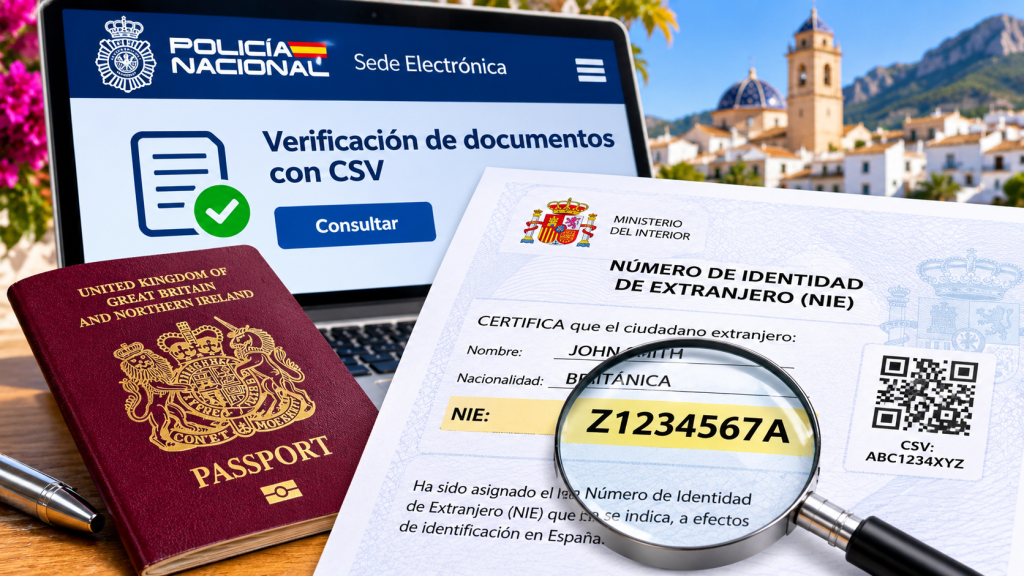
The Spanish National Police operates an official electronic document verification service through its Sede Electrónica.
This service allows users to check supported documents issued through the National Police’s document management system.
The verification process uses a Código Seguro de Verificación, commonly abbreviated to CSV.
What is a Código Seguro de Verificación?
A Código Seguro de Verificación is a secure verification code associated with an official administrative document.
It allows a recipient to retrieve or compare the corresponding document through the issuing authority’s electronic verification service.
Where supported, this helps establish whether the document has been issued through the relevant official system and whether its contents have been altered.
The CSV is different from the NIE number itself.
It is also different from the number printed on certain Spanish residence cards known as the número de soporte.
How to check an NIE certificate using a CSV
If your NIE certificate contains a compatible secure verification code, follow these steps:
- Visit the official Spanish National Police electronic headquarters.
- Locate the document verification service, called Verificación de documentos con CSV.
- Enter the secure verification code printed on your document.
- Complete the security verification requested by the website.
- Retrieve the corresponding official document if it is available.
- Compare the official document with the certificate you have received.
In certain circumstances, additional electronic identification may be required.
Official National Police document verification service:
https://sede.policia.gob.es/sede/pages/publico/verificaCSV.xhtml
If the document is successfully retrieved, compare the personal details, NIE number, issuing authority and other relevant information carefully.
Simply finding a working verification code is not sufficient if the document you have been presented with contains different information from the official version.
What if my NIE certificate does not have a CSV or QR code?
Not every Spanish NIE number certificate contains a secure electronic verification code.
Many foreign nationals obtained their NIE numbers years or even decades ago, before electronic document verification became widely available.
Paper certificates issued through traditional administrative procedures may contain official signatures, stamps or other authentication features instead.
The absence of a CSV or QR code does not automatically mean that an NIE certificate is fraudulent.
If your document cannot be checked electronically, you may need to contact the original issuing authority or request a replacement certificate.
The Spanish National Police’s electronic verification service is designed to authenticate supported documents. It is not a universal public database containing every NIE number certificate ever issued.
Can I verify an NIE number by scanning a QR code?
Some electronically generated Spanish administrative documents contain QR codes that provide convenient access to verification services.
However, a QR code alone does not establish that a certificate is genuine.
QR codes can direct users to unofficial or misleading websites.
When scanning a code on an NIE certificate:
- Check that the destination belongs to the relevant official government authority.
- Be cautious if the website requests payment to authenticate the certificate.
- Do not provide unnecessary personal or financial information.
- Compare the retrieved official document with the certificate in your possession.
- Access the government’s verification portal directly if you are uncertain.
A QR code should be treated as an access method rather than independent evidence of authenticity.
How to verify an NIE number through the Spanish tax office
Another way to check identification details is through the Agencia Tributaria, Spain’s national tax agency.
The Agencia Tributaria provides a service called:
Comprobación de un NIF de terceros a efectos censales
This service allows authorised users to check identification details against the Spanish taxpayer census.
For foreign individuals, the NIE generally also serves as their Spanish fiscal identification number.
The service can be particularly useful for businesses, accountants and professionals who need to confirm identification details for tax-related purposes.
How to access the Agencia Tributaria verification service
Visit the Agencia Tributaria electronic headquarters and locate the identification verification service within the Modelo 030 procedures.
Access generally requires an accepted electronic identification method, such as:
- A Spanish digital certificate.
- Cl@ve.
- Electronic DNI, where applicable.
The service allows users to submit an identification number alongside the relevant personal details.
Depending on the result, it may confirm a match or indicate discrepancies in the supplied information.
Official instructions are available here:
Does an Agencia Tributaria check prove an NIE certificate is genuine?
Not necessarily.
The tax office verification service checks identification information within the relevant tax records. It does not independently authenticate every NIE certificate issued by the Spanish National Police.
It is therefore a useful additional check rather than a replacement for official document authentication.
Access to these services should be limited to legitimate purposes and must comply with applicable data protection requirements.
Why is my genuine NIE number not recognised by the Spanish tax office?
This is a relatively important administrative issue for foreign nationals conducting financial transactions in Spain.
Receiving an NIE number from the Spanish National Police does not necessarily mean that the holder is correctly registered within every relevant government database.
Possible explanations for an NIE number not being recognised include:
- The individual has not been registered in the Spanish taxpayer census.
- The name has been entered differently from the official records.
- Middle names or surnames have been omitted.
- The NIE number contains a typing error.
- Personal information needs updating.
- The individual holds older identification documentation requiring clarification.
Where taxpayer registration or personal information needs updating, the relevant procedure may involve Modelo 030.
An NIE number not appearing in the Agencia Tributaria system does not automatically establish that it is fake.
Can I check who owns an NIE number online?
There is no general public service that allows anyone to enter an NIE number and retrieve unrestricted personal information about its holder.
Spanish NIE numbers constitute personal data and their use is subject to applicable Spanish and European data protection legislation.
Certain authorised professionals and government services may be able to verify identification details for specific legal or administrative purposes.
However, websites claiming to provide unrestricted access to the personal information of every NIE number holder should be treated with caution.
You should not attempt to obtain private information about another person without an appropriate lawful basis.
How to identify a potentially fake NIE number certificate
Although the appearance of NIE certificates can vary depending on the issuing authority and date of issue, certain discrepancies should prompt further investigation.
Potential warning signs include:
- An NIE number that does not follow the recognised format.
- A name that differs from the holder’s passport.
- Obvious alterations to identification details.
- Inconsistent dates or personal information.
- A verification code that retrieves a different document.
- A QR code directing users to an unofficial website.
- Unexplained differences between the certificate and other official records.
- A company claiming to issue official NIE numbers independently of the Spanish authorities.
- Requests for unusual payments in connection with document verification.
None of these factors should be considered conclusive in isolation.
Administrative errors, older documentation and changes in personal circumstances can also create inconsistencies.
Where there is a significant financial or legal transaction involved, obtain independent professional verification before proceeding.
Is an EX-15 application form proof of an NIE number?
No.
The EX-15 is the application form used to request an NIE number or certain related certificates.
Completing an EX-15 form does not mean that an NIE number has been officially assigned.
Similarly, the following documents do not independently establish that an NIE number has been issued:
- An NIE appointment confirmation.
- A completed government fee payment form.
- A receipt from an administrative service provider.
- A handwritten NIE number on an application form.
- An email confirming that an application is being prepared.
An officially assigned NIE number should be supported by appropriate documentation from the competent Spanish authorities.
The Spanish tax agency specifically distinguishes recognised evidence of an NIE from an application form on which a number has merely been handwritten.
Can an NIE number be verified using a Spanish TIE card?
A Spanish Tarjeta de Identidad de Extranjero, commonly known as a TIE card, displays the holder’s NIE number.
The TIE is an official identity document connected to the holder’s immigration status in Spain.
For individuals who already hold a valid TIE card, it may provide suitable evidence of their NIE number for many administrative procedures.
EU citizens registered as residents in Spain may similarly have their NIE number displayed on their Certificado de Registro de Ciudadano de la Unión Europea.
These documents should not be confused with the standalone white NIE number certificate.
| Document | Contains an NIE number | Independently establishes residency |
|---|---|---|
| White NIE number certificate | Yes | No |
| Spanish TIE residence card | Yes | According to the status granted |
| EU citizen registration certificate | Yes | Documents EU residence registration |
| EX-15 application form | May contain one | No |
| Modelo 790 payment receipt | May contain one | No |
| NIE appointment confirmation | May contain one | No |
Does an NIE number expire?
An assigned NIE number does not ordinarily expire simply because the certificate on which it appears is old.
However, certain authorities, banks, notaries or other organisations may request recently issued documentation.
This does not necessarily mean that the NIE number itself has expired.
For example, someone who purchased a Spanish property in 2005 and has not returned to Spain for many years would generally not need an entirely new NIE number merely because their original certificate is old.
They may, however, need updated documentary evidence of their existing number.
Applicants should avoid requesting a new identification number when one has already been assigned.
How should estate agents verify an NIE number in Spain?
Spanish estate agents regularly deal with international buyers and sellers.
Incorrect or fraudulent identification information can create delays in property transactions and potentially expose the parties involved to financial losses.
A sensible verification process may include checking the client’s passport against their NIE documentation, confirming identification details through appropriate authorised channels and referring significant discrepancies to the solicitor or notary handling the transaction.
Where electronic verification is available, it should form part of the document checking process.
Estate agents must also ensure that their collection and storage of personal identification documents complies with applicable data protection and, where relevant, anti-money-laundering obligations.
What should I do if I suspect my NIE certificate is fake?
If you believe you have received a fraudulent NIE number certificate, you should avoid using it for further transactions until the issue has been investigated.
Keep copies of relevant correspondence, payment receipts and the documentation you received.
Contact the Spanish National Police or the appropriate issuing authority to request advice on confirming the document.
If you believe you have been the victim of fraud, consider making a formal police report.
Depending on the circumstances, you may also wish to contact your bank or obtain independent legal advice.
Remember that legitimate private NIE assistance companies can help prepare documents and arrange appointments, but the official assignment of an NIE number remains the responsibility of the competent Spanish authorities.
How can I protect my Spanish NIE number from identity theft?
An NIE number is an important piece of personal information.
Although knowing someone’s NIE number does not automatically allow access to their bank accounts or government services, it may form part of a wider identity fraud attempt.
We recommend taking the following precautions:
- Avoid publishing photographs of your NIE certificate on social media.
- Do not send copies of identification documents to unknown individuals.
- Use official government websites when checking documents.
- Be cautious about websites offering unofficial NIE verification services.
- Keep your original documentation secure.
- Protect your Spanish digital certificate and its password.
- Investigate unexpected correspondence involving your Spanish identity or tax records.
Before sharing your NIE documentation, establish who is requesting it, why they require it and how it will be handled.
Frequently asked questions about NIE number verification
Can I verify my Spanish NIE number for free?
Certain official verification services are available without a separate verification fee. However, access conditions apply and not all certificates can be checked online.
Does a valid NIE control letter prove that an NIE number is genuine?
No. It confirms only that the number satisfies the relevant mathematical validation rules.
Can I verify an NIE number using only a passport number?
There is no general public government service that allows unrestricted NIE number searches using another person’s passport number.
If you have lost your own NIE documentation, contact the appropriate Spanish authority for advice.
Can a genuine NIE number begin with Z?
Yes. Modern Spanish NIE numbers can begin with X, Y or Z.
Is an NIE number beginning with M genuine?
An identification number beginning with M may be a Spanish fiscal identification number assigned under specific circumstances. However, it is not a standard police-issued NIE number.
There is an important legal and administrative difference between an NIE and an alternative tax identification number.
Is an emailed NIE certificate legally valid?
An electronically issued certificate may be valid if it has been properly issued and authenticated by the relevant authority. Receiving a document by email does not automatically make it genuine or fraudulent.
Can my NIE number be changed when I renew my passport?
Ordinary passport renewal does not require a new NIE number. However, you may need to update your passport details with relevant organisations.
Is a photocopy of an NIE certificate sufficient?
This depends on the procedure and the organisation requesting the documentation. Some organisations may require an original, an authenticated electronic document or a certified copy.
Can a private company issue an NIE number?
No. Private service providers can assist with the application process, but official NIE numbers are assigned by the competent Spanish authorities.
Need help obtaining an official Spanish NIE number?
At NIE Numbers Spain, we assist international clients with the Spanish NIE number application process, including appointment arrangements and preparation of the relevant paperwork.
Whether you are buying a property in Spain, dealing with an inheritance, establishing business interests or simply need a Spanish NIE number for another legitimate purpose, our service helps you navigate the application process.
If you already have an NIE number but have lost your certificate, establish whether you need replacement documentation rather than applying for an entirely new number.
Visit www.nienumbers.es to learn more about obtaining your Spanish NIE number.
Official Spanish government sources and further reading
The following official resources provide further information about NIE number structures, identification requirements and document verification.
- Spanish National Police – Official document verification service
- Spanish National Police – Electronic headquarters in English
- Agencia Tributaria – Official NIE and NIF number structures
- Agencia Tributaria – Verification of third-party fiscal identification numbers
- Agencia Tributaria – Modelo 030 registration and personal information procedures
- Spanish Data Protection Agency
Conclusion
Verifying the authenticity of a Spanish NIE number certificate involves more than simply checking its letters and numerical characters.
Mathematical validation, official document verification, tax registration checks and confirmation of the holder’s identity each serve a different purpose.
Where possible, use the official Spanish National Police verification service and other authorised government channels.
Understanding the difference between a correctly formatted NIE number and a genuinely assigned identification number can help protect individuals and businesses from administrative errors, identity fraud and unnecessary financial risks.
This article provides general information about Spanish identification documents and official verification procedures. It does not constitute an individual document authentication service or legal advice.
Further Reading: Spanish NIE Number Guides and Useful Information
At NIE Numbers Spain, we provide comprehensive information about obtaining, managing and understanding your Spanish NIE number. If you found this guide to NIE number verification useful, you may also be interested in the following articles:
- How to Get an NIE Number in Spain – Complete 2027 Guide – Everything you need to know about applying for an official Spanish NIE number, including documentation, appointments and application requirements.
- Top 50 Most Asked Questions About NIE Numbers in Spain – Discover answers to common questions about NIE number validity, lost certificates, replacement documents and Spanish identification requirements.
- NIE Numbers and Spanish Residency: Questions and Answers – Understand the important differences between an NIE number, Spanish residency and immigration documentation.
- What to Do at Your NIE Number Appointment in Spain – A step-by-step guide to attending your Spanish National Police appointment and obtaining your NIE number certificate.
- Spanish NIE Application Forms EX-15, EX-18 and Modelo 790 Explained – Learn about the official Spanish application forms, government fees and common documentation mistakes.
- How to Get an NIE Number in Alicante and the Costa Blanca – Our detailed regional guide to obtaining an NIE number in Alicante.
Whether you need to obtain your first Spanish NIE number, understand your existing documentation or request a replacement certificate, NIE Numbers Spain provides practical information to help you navigate the Spanish administrative system.