
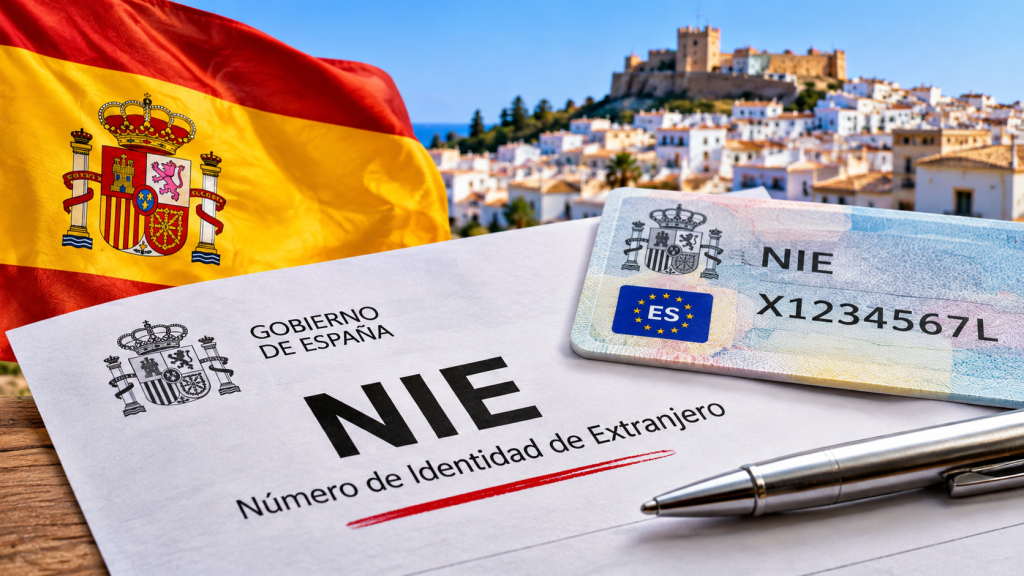
Millions of foreign nationals have been allocated a Spanish NIE Number, yet relatively few people understand how these numbers are generated, what their individual characters mean or how Spanish government departments verify them.
A NIE Number is considerably more than a reference number printed on a piece of paper. It forms part of Spain’s national identification infrastructure, allowing government departments, financial institutions and other organisations to identify foreign nationals consistently.
In this comprehensive guide, NIE Numbers Spain examines the technical structure of the Spanish NIE Number, its legal foundations, the official validation process and what you should do if your NIE Number is not recognised.
What is the legal definition of a NIE Number?
The NIE, officially known as the Número de Identidad de Extranjero, is a personal identification number allocated to foreign nationals who have relevant connections with Spain.
The legal framework governing the allocation of NIE numbers is established under Spanish immigration legislation.
Article 205 of Royal Decree 1155/2024 defines the NIE as a personal, unique, exclusive and sequential identification number.
Foreign nationals may be allocated a NIE Number because of their:
- Economic interests in Spain.
- Professional activities.
- Social connections.
- Immigration or residency applications.
- Property ownership or investment.
- Other relevant connections with Spanish administration.
The NIE Number allows Spanish authorities to associate administrative records with a particular individual.
Importantly, possessing a NIE Number does not automatically grant its holder Spanish residency or permission to work in Spain.
What does a Spanish NIE Number look like?
A standard Spanish NIE Number consists of nine characters:
- One initial letter.
- Seven numerical digits.
- One final verification letter.
A fictional example of a correctly formatted NIE Number is:
X1234567L
Each component serves a different purpose within the identification system.
Unlike identification systems used in some other countries, the standard NIE Number does not directly reveal an individual’s date of birth, nationality or gender.
What do the X, Y and Z letters mean on a NIE Number?
Spanish NIE numbers normally begin with one of three letters:
NIE numbers beginning with X
The X prefix was used for earlier sequences of foreign identification numbers.
Many foreign residents who established connections with Spain years ago continue to hold NIE numbers beginning with X.
NIE numbers beginning with Y
As the numbering system expanded, additional sequences were introduced using the letter Y.
There is no difference in the legal status of a NIE Number beginning with X and one beginning with Y.
NIE numbers beginning with Z
The letter Z provides another series within the Spanish foreign identification numbering system.
The initial letter does not indicate the holder’s nationality, immigration status, tax residency or entitlement to live in Spain.
A British, German, French or American national could hold a NIE Number from the same numbering series.
What does the final letter of a NIE Number mean?
The final letter is known in Spanish as the dígito de control, or control character.
Unlike a randomly selected letter, it is calculated using a mathematical formula.
Its purpose is to help identify errors when a NIE Number is entered into administrative or commercial systems.
For example, if someone accidentally enters an incorrect digit when completing a Spanish tax declaration, the validation process may detect that the number and its final letter do not correspond.
This reduces the likelihood of incorrect identification numbers being accepted.
However, mathematical validation alone cannot establish whether a NIE Number has genuinely been allocated to a particular person.
How is a Spanish NIE Number validated?
The Spanish Ministry of the Interior publishes the official calculation used to verify the control character of Spanish NIE numbers.
The process begins by replacing the opening letter with a numerical value:
| Initial letter | Numerical value |
|---|---|
| X | 0 |
| Y | 1 |
| Z | 2 |
The resulting numerical sequence is divided by 23. The remainder determines the final verification letter.
The official sequence of verification letters is:
TRWAGMYFPDXBNJZSQVHLCKE
Each letter corresponds to a remainder between zero and 22.
Example of NIE Number validation
Consider the fictional example:
X1234567L
First, replace the initial X with zero.
This produces:
01234567
Dividing the resulting number by 23 produces a remainder of 19.
The letter corresponding to remainder 19 is L.
The example therefore passes the mathematical NIE Number validation check.
Passing this calculation does not confirm that the number belongs to a real person or has been officially issued.
Can you check whether a NIE Number is genuine online?
There is an important distinction between checking whether a NIE Number is mathematically correct and verifying whether it has been officially allocated.
A standard online NIE Number checker can establish whether:
- The number contains the correct number of characters.
- The initial letter is recognised.
- The numerical sequence is correctly formatted.
- The final verification letter matches the official calculation.
It cannot necessarily establish:
- Whether the Spanish police issued the number.
- Who owns the NIE Number.
- Whether the holder has Spanish residency.
- Whether the holder has permission to work.
- Whether the holder is registered with the Spanish tax authorities.
There is no general public database that allows anyone to enter a NIE Number and retrieve the holder’s complete personal information.
How do Spanish government departments verify NIE numbers?
Spain operates electronic identity verification services that allow authorised public authorities to check identification information against official records.
These services include systems operated using information held by the Dirección General de la Policía.
Depending on their permissions and administrative purpose, public authorities may be able to verify whether the information submitted matches the official identity records.
This can help government departments identify inconsistencies involving names, surnames and identification numbers.
Such systems are different from publicly available mathematical NIE Number validators.
Why is my NIE Number not recognised?
Foreign nationals occasionally encounter situations where a correctly issued NIE Number is rejected by a website, bank, government department or commercial organisation.
There are several possible explanations.
1. Incorrect formatting
Many Spanish electronic systems require the complete NIE Number to be entered without spaces or hyphens.
Check that all nine characters have been entered correctly.
2. An incorrect verification letter
A typing error in the final letter or numerical sequence may cause the number to fail automatic validation.
Always compare the number with your original official documentation.
3. Your personal information does not match
Spanish administrative systems may verify your name and surnames alongside your NIE Number.
Differences in spelling, double surnames, previous names or passport information can occasionally cause identification difficulties.
4. Your NIE Number is not registered with the appropriate department
Being allocated a NIE Number by the Spanish police does not necessarily mean every administrative registration has been completed.
For example, additional steps may be necessary to register or update your details with the Agencia Tributaria for tax purposes.
5. The system requires a different identification document
Some online procedures require a residence document or an additional document support number.
A person may have a perfectly valid NIE Number but lack the additional identification information necessary to complete a particular online procedure.
6. The organisation’s software is incorrectly configured
Some commercial systems may not correctly accommodate foreign identification numbers.
If your official documentation is correct, contact the organisation and ask whether its system accepts Spanish NIE numbers rather than only Spanish DNI numbers.
What is the difference between a NIE Number and a document support number?
One of the most common sources of confusion when using Spanish online government services is the distinction between the NIE Number and the número de soporte.
The NIE Number identifies the individual.
The support number identifies a particular identity or residency document.
Depending on the document you hold, the support number may appear in a different location and use a different format.
When registering for services such as Cl@ve, you may be asked to provide both numbers.
A correct NIE Number does not guarantee successful registration if the document support number is missing or entered incorrectly.
Does a NIE Number change when you renew your passport?
Generally, no.
The NIE Number is allocated to the individual rather than permanently attached to a particular passport.
Renewing your British, Irish, American or other foreign passport does not normally result in a new NIE Number.
However, you may need to update your passport details with the relevant Spanish authorities or organisations.
This distinction is particularly important for foreign property owners, taxpayers and long-term residents.
Can one person have two NIE numbers?
The Spanish legal framework establishes the NIE as a unique personal identifier.
Under normal circumstances, an individual should not have two independently allocated NIE numbers.
If you discover documentation containing two different NIE numbers associated with your identity, you should contact the Spanish National Police to investigate and resolve the discrepancy.
Do not simply choose whichever number is more convenient to use.
Duplicate identity records could potentially cause complications involving taxation, property ownership, employment or immigration records.
Does an old NIE Number remain valid?
The identification number itself is generally permanent.
However, the validity of the document displaying your NIE Number is a separate matter.
A residence card may expire, and an organisation may request a recently issued NIE certificate or updated identification documentation.
This does not ordinarily mean that a completely new NIE Number must be allocated.
If you previously lived in Spain and are now returning, you should establish whether you already have a NIE Number before submitting a new application.
Is a NIE Number the same as a Spanish NIF?
The NIF, or Número de Identificación Fiscal, is the identification number used for Spanish tax purposes.
For foreign individuals who have been allocated a NIE, that number generally also serves as their fiscal identification number.
However, the terms NIE and NIF describe different administrative functions.
The NIE identifies a foreign national, while the NIF is used within the taxation system.
Registering or updating your tax identification information may still be necessary depending on your activities in Spain.
Can someone steal or misuse my NIE Number?
A NIE Number is personal information and should be treated accordingly.
Although knowing someone’s NIE Number does not automatically provide access to their bank accounts or government records, it could potentially be combined with other personal information for fraudulent purposes.
Avoid publicly sharing photographs of documents containing:
- Your NIE Number.
- Passport details.
- Date of birth.
- Signature.
- Home address.
- Residence card support number.
Always check the legitimacy of websites requesting your identification information.
Be particularly cautious of unofficial websites claiming to offer access to confidential Spanish government identity databases.
What should I do if my NIE Number is incorrect?
If you believe there is an error in your official documentation, you should contact the relevant Spanish authority.
Depending on the nature of the problem, this could involve:
- The Policía Nacional.
- The relevant immigration office.
- The Agencia Tributaria.
- The organisation holding the incorrect information.
Take your original passport, NIE documentation and any evidence demonstrating the discrepancy.
Do not attempt to correct an official identification number yourself by changing a digit or calculating an alternative verification letter.
The mathematical formula is a validation mechanism, not a method of obtaining an official NIE Number.
How can I obtain an official NIE Number in Spain?
If you have never been allocated a Spanish NIE Number and require one for property ownership, investment, professional activities or another legitimate purpose, you will need to follow the official application procedure.
This will generally involve the appropriate application form, identity documentation, supporting evidence and payment of the applicable administrative fee.
Application requirements depend on your circumstances and the procedure being undertaken.
Visit our main NIE Number application guide for further information about obtaining your Spanish foreign identification number.
Professional assistance with appointment arrangements and preparing NIE application documentation is also available through MY NIE.
Frequently asked questions about Spanish NIE numbers
How many characters does a NIE Number have?
A standard NIE Number contains nine characters: an initial letter, seven numerical digits and a final verification letter.
Can a NIE Number begin with the letter A?
A standard Spanish NIE Number begins with X, Y or Z.
Can I calculate my own NIE Number?
No. You can calculate the expected verification letter of an existing numerical sequence, but only the competent Spanish authorities can officially allocate a NIE Number.
Can I find someone’s name from their NIE Number?
There is no general public government database allowing unrestricted access to a person’s identity using their NIE Number.
Does a NIE Number show my age?
No. The number does not directly encode your date of birth.
Does a NIE Number show my nationality?
No. Its prefix and numerical sequence do not directly identify your nationality.
Can my NIE Number be valid without Spanish residency?
Yes. Non-residents can hold a NIE Number for legitimate economic, professional or other connections with Spain.
Does a valid NIE Number mean I can legally work in Spain?
No. Employment rights depend on nationality, immigration status and any applicable work authorisation.
Official Spanish government sources
For further technical and legal information, consult the following official resources:
- Spanish Ministry of the Interior – Official NIE and NIF validation formula
- Spanish Official State Gazette – Royal Decree 1155/2024, Article 205
- Spanish Government – Identity Data Verification Service
- Spanish Tax Agency – Identification errors and Cl@ve registration
Conclusion
The Spanish NIE Number is a fundamental component of Spain’s administrative identification system.
Understanding its structure, mathematical validation process and legal purpose can help foreign nationals avoid administrative errors and resolve identification problems.
Whether you are purchasing property, establishing a business, moving to Spain or managing existing Spanish interests, understanding your NIE Number is an important part of navigating Spanish administration.
At www.nienumbers.es, our objective is to provide comprehensive, accurate and accessible information about the Spanish NIE Number system, helping foreign nationals understand both the application process and the legal and administrative framework behind it.
Further reading: Your complete guide to Spanish NIE Numbers
Understanding your Spanish NIE Number is essential when dealing with Spanish government departments, financial institutions and legal procedures. Explore our additional guides to learn more about obtaining and using your NIE Number in Spain.
– How to get a NIE Number in Spain – Complete application guide – Everything you need to know about obtaining your Spanish NIE Number, including application forms, appointments and requirements.
– What to do at your NIE Number appointment – Discover which documents to bring, how to prepare and how to avoid common application mistakes.
– How to get a NIE Number in Alicante and the Costa Blanca – Our comprehensive guide to obtaining your NIE in Alicante province.
– How to get a NIE Number in Madrid – A step-by-step guide to appointments, documentation and application procedures in the Spanish capital.
– How to get a NIE Number in Málaga and the Costa del Sol – Everything you need to know about NIE applications in Málaga, Marbella, Mijas and surrounding areas.
– How to obtain a NIE Number in Benidorm – Local information about applying for your Spanish identification number in Benidorm.
– How to get a NIE Number in Cádiz – Our dedicated guide to obtaining your NIE Number in Cádiz province.
At NIE Numbers Spain, we are committed to providing accurate, comprehensive and up-to-date information about the Spanish NIE Number system, helping foreign nationals navigate Spanish administrative procedures with confidence.