
If you are moving to Spain, buying property, applying for official documentation or dealing with Spanish authorities, you may be asked to provide documents issued in another country.
These might include birth certificates, marriage certificates, criminal record certificates, academic qualifications, powers of attorney or company documents.
However, a document issued abroad is not automatically accepted by every Spanish authority.
Depending on the country of origin, the type of document and the procedure involved, you may need an apostille, diplomatic legalisation or an official Spanish translation.
Understanding the differences is essential because completing the wrong process can lead to delays, additional costs or rejected paperwork.
This guide explains how foreign documents are prepared for use in Spain and where to find the relevant official requirements.
What Is an Apostille?
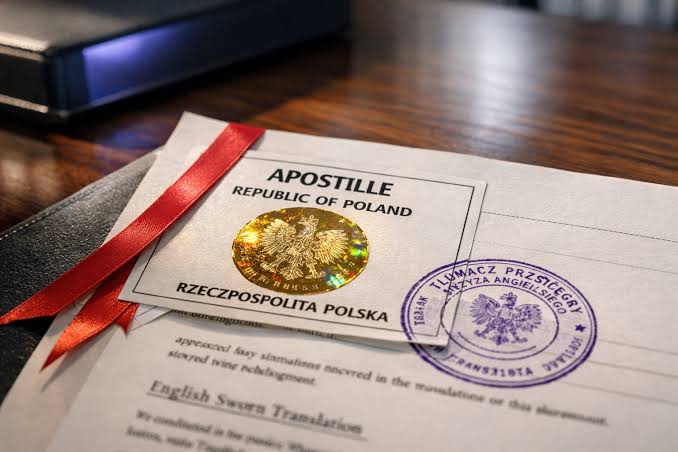
An apostille is an official certificate that authenticates the origin of a public document for use in another country that participates in the 1961 Hague Apostille Convention.
It confirms matters such as the authenticity of the signature, the capacity in which the person signing acted and, where applicable, the identity of the seal or stamp.
An apostille does not confirm that the contents of a document are factually correct.
For example, if you have a birth certificate issued in the United Kingdom, an apostille may authenticate the official signature or seal associated with that certificate.
It does not independently verify the information recorded on the birth certificate.
Spain is a party to the Hague Apostille Convention.
You can check participating countries and their designated authorities through the Hague Conference on Private International Law.
When Do You Need an Apostille for Spain?
You may need an apostille when presenting a foreign public document to a Spanish authority and no exemption or alternative international agreement applies.
Examples include:
- Birth certificates.
- Marriage certificates.
- Death certificates.
- Certain criminal record certificates.
- Court documents.
- Notarial documents.
- Certain official educational documents.
- Powers of attorney.
- Company documents.
However, not every foreign document needs an apostille.
The requirement depends on the document, the country that issued it and the rules governing its use in Spain.
It is always advisable to ask the Spanish authority or professional requesting the document before arranging authentication.
Apostille vs Legalisation: What Is the Difference?
These are two different ways of authenticating foreign public documents.
Apostille
The apostille process applies between countries where the Hague Apostille Convention is in force for the relevant relationship.
The apostille replaces the traditional chain of diplomatic or consular legalisation covered by the Convention.
Diplomatic or Consular Legalisation
If the apostille system does not apply, a document may need to go through a legalisation process involving the relevant authorities in the country of origin and, where required, the Spanish diplomatic or consular authorities.
The precise sequence depends on the country and the document.
The Spanish Ministry of Foreign Affairs explains the applicable procedures on its official legalisation and apostille page.
Important: Do not assume that a document needs an apostille simply because it was issued abroad. Some documents are exempt from legalisation under EU regulations or other international agreements.
Do Documents Issued in Other EU Countries Need an Apostille?
In many cases, no.
EU Regulation 2016/1191 simplifies the circulation of certain public documents between EU Member States.
For documents covered by the Regulation, an apostille is no longer required when they are presented to the authorities of another participating Member State.
The Regulation covers certain public documents relating to:
- Birth.
- Death.
- Name.
- Marriage.
- Registered partnership.
- Residence and domicile.
- Nationality.
- Absence of a criminal record.
It also introduces optional multilingual standard forms that can help avoid translation requirements.
However, the Regulation does not cover every type of document or every legal consequence of the document.
For example, it does not mean that every foreign academic qualification or commercial document is automatically accepted without further formalities.
You can read more through the European e-Justice Portal’s public documents information.
What Is a Sworn Translation in Spain?
A sworn translation is an official translation completed by a translator authorised under the relevant Spanish rules.
In Spain, these translators are known as traductores jurados.
They are recognised by the Spanish Ministry of Foreign Affairs, European Union and Cooperation.
A sworn translation is often required when submitting foreign-language documents to Spanish public authorities.
Examples include:
- Foreign birth certificates.
- Marriage certificates.
- Divorce decrees.
- Educational qualifications.
- Court judgments.
- Company documentation.
- Foreign powers of attorney.
A standard translation completed by an ordinary translation company may not be sufficient.
The authority receiving the document determines the translation requirements.
How to Find an Official Sworn Translator
The safest approach is to use the official directory maintained by the Spanish Ministry of Foreign Affairs.
Visit the Ministry’s official translation and legalisation information and consult its list of recognised sworn translators.
Before commissioning a translation, confirm:
- The translator is authorised for the relevant language combination.
- The translation is suitable for the intended Spanish administrative procedure.
- The complete document, including relevant seals and annotations, is translated.
- The receiving authority accepts the proposed format.
The Ministry states that translations completed by its recognised sworn translators are valid in Spain without requiring further legalisation by its Legalisation Service.
Does the Document Need an Apostille Before Translation?
This depends on the document and the authority receiving it.
A common practical sequence, where both authentication and translation are required, is:
- Obtain the original official document.
- Arrange the required apostille or legalisation.
- Have the complete authenticated document translated by an accepted sworn translator.
- Submit the original document and translation together.
This sequence helps ensure that the apostille itself, including its stamps and annotations, is also translated.
However, always confirm the required order before starting. Some authorities may have specific requirements for originals, certified copies or translation formats.
Step-by-Step Example: Using a Foreign Birth Certificate in Spain
Imagine that you are moving to Spain and need to provide your birth certificate for an administrative procedure.
The process could involve the following steps.
Step 1: Obtain the correct certificate
Request an official certificate from the relevant civil registration authority in your country.
Check whether the Spanish authority requires a recent certificate.
Step 2: Check whether an apostille is required
Determine whether the issuing country participates in the Hague Apostille Convention and whether an exemption applies.
If the document is issued in another EU Member State and falls within Regulation 2016/1191, an apostille may not be required.
Step 3: Arrange the necessary authentication
If an apostille is required, contact the designated authority in the country that issued the document.
Do not assume that the Spanish Embassy is responsible for issuing apostilles for foreign documents.
Step 4: Arrange an official Spanish translation
If the document is not in Spanish and a translation is required, use a recognised sworn translator.
Step 5: Submit the complete documentation
Present the documents in the format requested by the Spanish authority.
Keep copies of everything you submit.
What About Documents Used for an NIE Application?
Foreign documents are not automatically required for every NIE application.
The documentation depends on the reason for requesting the NIE and the specific procedure being followed.
For example, someone applying for an NIE because they are purchasing property may face different supporting-document requirements from someone applying because of employment or another administrative reason.
Do not arrange apostilles or sworn translations unnecessarily.
First establish which documents are actually required.
You can find more information about NIE procedures on NIE Numbers.
Do Foreign Criminal Record Certificates Need Legalisation?
They may do, depending on the country of issue and the procedure for which the certificate is required.
A criminal record certificate issued abroad might need an apostille or another form of legalisation.
A Spanish authority may also require a translation into Spanish.
Some procedures have additional rules about how recently the certificate must have been issued.
This is particularly important for immigration and employment-related procedures.
Always check the requirements of the specific application rather than assuming that the rules are the same for every certificate.
How Much Does an Apostille or Sworn Translation Cost?
There is no single fee applicable worldwide.
Apostille fees are determined by the relevant authority in the country issuing the apostille.
Some countries offer free apostilles, while others charge a fee.
Translation costs depend on:
- The language combination.
- The number of pages.
- The length and complexity of the document.
- The translator’s pricing structure.
- Whether urgent delivery is requested.
Spain’s Ministry of Foreign Affairs states that its own legalisation service is free, although other authorities involved in the process may charge fees.
Common Mistakes to Avoid
Ordering an apostille before checking whether one is necessary
Some documents benefit from exemptions under EU regulations or international agreements.
Using an ordinary translation instead of a sworn translation
A translation that is perfectly accurate may still fail to meet the formal requirements of a particular Spanish procedure.
Translating the document before authentication
Where an apostille is required, the authority may need the apostille and its associated information to be included in the translated document.
Assuming that all documents have unlimited validity
An apostille does not extend the validity of the underlying document.
If a certificate has a time limit, the apostille does not change that.
Assuming the same rules apply to every Spanish authority
Different procedures may have different documentation requirements.
Always check with the receiving authority.
Frequently Asked Questions
Is an apostille the same as notarisation?
No. Notarisation and apostille authentication are different processes. An apostille authenticates the origin of a public document or the relevant notarised act for international use under the Convention.
Can I apostille a photocopy?
This depends on the country and the document. Some authorities can apostille certified copies or notarised copies, while others require the original public document.
Does a UK document need an apostille for Spain?
Some UK public documents may require an apostille before they can be used in Spain. However, the exact requirement depends on the document and the applicable international arrangements.
Can I use a sworn translation completed outside Spain?
Some foreign translations may be recognised under applicable rules, including certain EU arrangements. However, not every translation completed abroad will automatically be accepted by Spanish authorities.
Does an apostille expire?
An apostille itself does not normally have an expiry date. However, the underlying document may be subject to a validity period or recency requirement.
Can I translate my own documents?
A personal translation will not normally satisfy a requirement for an official sworn translation.
Final Thoughts
Preparing foreign documents for use in Spain can be confusing, especially when apostilles, legalisation and sworn translations are involved.
The key is to identify the requirements before spending money or sending original documents abroad.
Check the rules for the particular document, confirm whether an international exemption applies and use the official Spanish government resources whenever possible.
If you are dealing with Spanish administration for the first time, having the correct documentation can make the entire process considerably easier.
Need to obtain an NIE in Spain?
Visit www.nienumbers.es for information and assistance with the NIE application process.
Links