
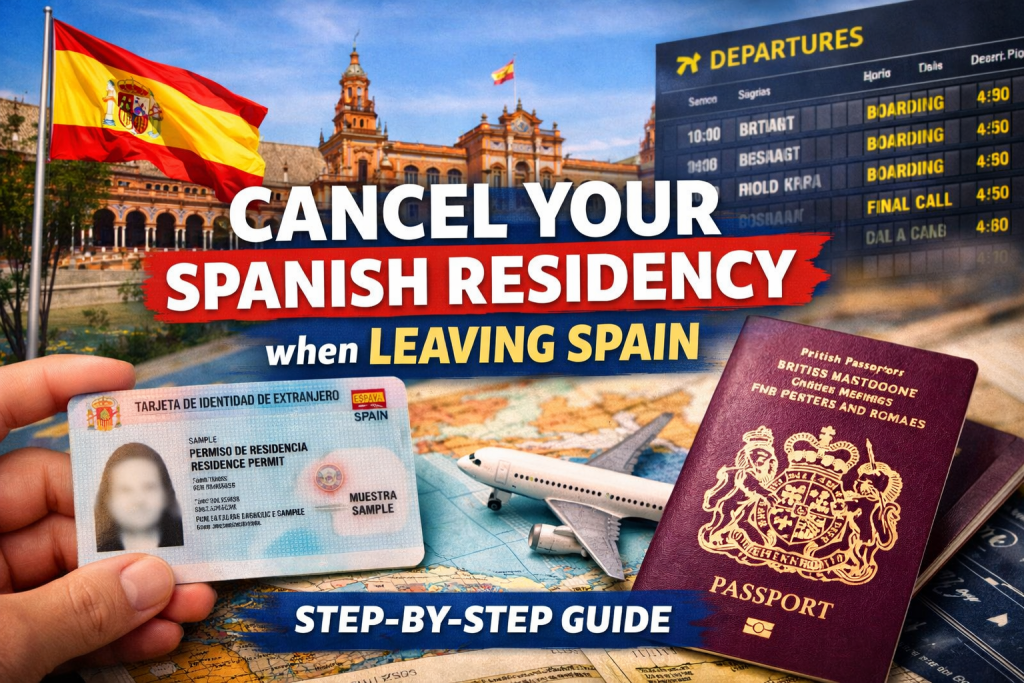
Leaving Spain permanently—whether you’re returning to the UK or moving elsewhere—requires more than just packing your bags. Many expats make the mistake of simply leaving without formally canceling their residency, which can lead to tax issues, legal complications, and problems re-entering Spain later.
This guide explains exactly how to cancel your residency in Spain, what happens to your NIE number, and the step-by-step process to leave correctly.
Important First: You Cannot Cancel Your NIE
Let’s clear up the biggest misconception straight away.
👉 Your NIE number cannot be cancelled.
Your Número de Identidad de Extranjero (NIE) is a lifetime identification number, similar to a tax number. It stays with you forever—even if you leave Spain permanently.
✔ You keep the same NIE if you return in the future
✔ It remains linked to property, bank accounts, or taxes
✔ It does not expire
👉 What you can cancel is your residency status, not your NIE.
Why You Must Cancel Your Residency Properly
Many people simply leave Spain and assume everything ends automatically. It doesn’t.
Failing to deregister can cause:
- Ongoing Spanish tax residency obligations
- Continued healthcare or social security links
- Problems proving non-resident status
- Fines or complications when returning
Spain considers you tax resident if you spend 183+ days per year in the country —so failing to formally leave the system can trigger unwanted tax exposure.
Overview: The 5 Key Steps to Leave Spain Properly
Here’s the correct order:
- Deregister from the Padrón (Town Hall)
- Cancel your Residency (TIE / EU Certificate)
- Notify Tax Authorities (Hacienda)
- Deregister from Social Security
- Close or update other obligations (bank, healthcare, etc.)
Let’s break each one down.
Step 1: Deregister from the Padrón (Empadronamiento)
The Padrón is your local municipal register (Ayuntamiento). This is the first and most important step.
👉 You must officially remove yourself from your town’s census.
How to do it
- Book an appointment at your local Town Hall (Ayuntamiento)
- Bring:
- Passport or TIE
- Proof of identity
- Request:
👉 “Baja del padrón” (removal from register)
This process is usually simple and quick .
Why this matters
Your padrón certificate proves:
- You no longer live in Spain
- You are not locally resident
- You can proceed with other cancellations
👉 You’ll receive a certificate of deregistration, which is needed for tax and immigration steps.
Step 2: Cancel Your Residency (TIE or EU Certificate)
This is the core legal step.
You must formally notify Spanish immigration that you are leaving.
Where to go
- Oficina de Extranjería (Immigration Office)
- OR Policía Nacional (Foreigners Department)
What you need
- Passport
- Residency card:
- TIE (non-EU)
- Green certificate (EU citizens)
- Padrón deregistration certificate
- Written declaration (or form)
What happens
- You submit a request to cancel residency
- You hand in your residence card
- Authorities update your status in the system
Non-EU citizens are required to return the TIE card .
You’ll receive:
👉 A stamped confirmation of cancellation
Alternative: Using a Form
In some cases, you may need to submit:
- EX-18 (EU residents)
- Or a written statement declaring:
👉 You are leaving Spain permanently
Some guidance also references ticking “baja por cese” (cancellation due to leaving) .
Step 3: Notify Spanish Tax Authorities (Hacienda)
This step is critical and often overlooked.
If you don’t do this, Spain may still treat you as a tax resident.
What to do
Submit:
👉 Modelo 030 (change of tax status)
You’ll need:
- Padrón deregistration certificate
- New address abroad
What you get
- Confirmation of non-resident status
- Removal from Spanish tax residency system
Tax authorities may request proof you now live in another country .
Step 4: Deregister from Social Security
If you worked or were self-employed, this step is mandatory.
Employees
- Your employer usually handles deregistration
Autónomos (self-employed)
You must:
- File “baja de autónomo”
- Do this within 3 days of stopping activity
Other cases
- Notify INSS (if receiving pension)
- Inform healthcare system
Step 5: Cancel Healthcare and Local Services
Before leaving Spain, ensure you:
- Return your health card (tarjeta sanitaria)
- Cancel:
- Doctor appointments
- Local services
This avoids misuse and administrative issues .
Step 6: Inform Your Bank and Update Financial Status
Don’t forget:
- Notify your Spanish bank
- Change account to non-resident account
This is essential if you:
- Own property
- Keep money in Spain
Do You Need to Return to Spain to Cancel Residency?
Not always—but it’s highly recommended.
Some processes can be done:
- Via representative (gestor/lawyer)
- Via written declaration
However:
👉 Many offices require in-person attendance, especially for handing in your residency card.
What Happens If You Don’t Cancel Residency?
This is where many expats get caught out.
If you leave without deregistering:
- Spain may still consider you resident
- You could be liable for:
- Income tax
- Wealth tax
- You may face complications returning later
Also:
👉 Residency is not automatically cancelled just because you leave .
Can You Become Non-Resident Without Cancelling?
Technically yes—but risky.
Spain determines residency by:
- Time spent (183+ days)
- Centre of economic interests
However, without formal cancellation:
❌ You may struggle to prove non-resident status
❌ Tax authorities may challenge your position
What If You Plan to Return to Spain?
Good news:
- Your NIE stays valid forever
- You can reapply for residency easily
- Your past records remain linked
In fact, keeping your NIE is beneficial for:
- Buying property again
- Opening bank accounts
- Reapplying for visas
Timeline: When Should You Start the Process?
Ideal timeline:
- 1–2 months before leaving Spain
- Book appointments
- Prepare documents
- Final 1–2 weeks
- Cancel padrón
- Submit residency cancellation
- Notify tax office
Common Mistakes to Avoid
❌ Not cancelling padrón
❌ Keeping residency active “just in case”
❌ Forgetting tax deregistration
❌ Not returning TIE card
❌ Leaving without proof of cancellation
👉 Always get written confirmation of deregistration.
Example Scenario (UK Citizen Leaving Spain)
If you’re a British expat:
- Deregister from padrón (Ayuntamiento)
- Cancel TIE at Policía Nacional
- Submit Modelo 030 to Hacienda
- Inform HMRC you’re back in the UK
- Update your Spanish bank account
Pro Tip (SEO + Real World)
For your audience:
👉 Many people search:
- “Cancel NIE Spain”
- “How to leave Spain permanently”
- “Do I need to cancel residency Spain”
You should target:
- “Cancel residency Spain”
- “Deregister Spain expats”
- “Leaving Spain tax obligations”
Final Checklist (Print This)
Before leaving Spain, make sure you have:
✔ Padrón deregistration certificate
✔ Residency cancellation confirmation
✔ Returned TIE / green certificate
✔ Modelo 030 submitted
✔ Social Security deregistered
✔ Healthcare cancelled
✔ Bank updated
Conclusion
Cancelling your residency in Spain is not complicated—but it must be done properly.
The key takeaway:
👉 You don’t cancel your NIE
👉 You cancel your residency, tax status, and registrations
Doing it correctly ensures:
- No future tax problems
- Clean legal exit
- Easy return to Spain later
Internal links